
Emotional Regulation for Mums with ADHD: How to reduce rage, burnout and overwhelm
Updated: 6 hours ago
**Please note that when I refer to Mum’s, I am referring to anyone who identifies as a Mum/Mom/Mother**
Emotional regulation for Mum's with ADHD can feel incredibly difficult, particularly when the demands of parenting leave you overstimulated, exhausted and running on empty. Internally comparing yourself to some sort of mythical neurotypical unicorn parent.
We all know that ADHD has been severely underdiagnosed and under-researched in women. Therefore, the majority of Mum's I meet, only gained a diagnosis once they became a mother. Either because their child received a diagnosis, or the demands of parenting has meant they are no longer able to mask or because of the hormonal shifts that happen during perimenopause and menopause. The demands of tasks such as organising your child’s playdate, packing snacks + lunches, remembering non-school uniform day, planning around changing and managing multiple schedules, remembering to pick your child up from school when in hyperfocus – the list goes on and on and on. Not to mention the unpaid work imbalance omnipresent in our society. You have probably heard that women still carry the burden of doing more of the unpaid work in heterosexual relationships. However, did you also know that according to the University of Bath, mothers still carry 67% more mental tasks – that is 67% more of an executive functioning load! Can you imagine the impact of this on Mum's with ADHD?
In this post, I will explain Mum’s and ADHD, why being a Mother can amplify ADHD challenges, the executive functioning demands of parenting and why you are not failing. I will share a few easy, small and practical steps to take, that will create some positive change.
ADHD and Emotional Dysregulation
You love your kids, but you might find yourself shouting, slamming the car door to harder than you meant to and quite literally stomping your feet in frustration.
Many Mums hear themselves saying:
“I won't react like that again,” only to reach the end of another chaotic day and feel your patience disappear.
And asking yourself:
Why did I get so angry about something so ridiculous?
Why can't I just stay calm like other Mums seem to?
What is wrong with me?
As an Occupational Therapist specialising in Neurodivergence, I often have women coming to me saying that they are struggling to cope, to keep up with the demands, to be able to manage themselves, as well as their child’s needs. To maintain an even keel, even though the lived experience of being a neurodivergent woman comes with different challenges.
And the shame, oh my, the shame. Brene Brown (one of my favourite authors) defines shame as the intensely painful feeling; or the experience of believing that we are flawed and therefore not worthy of belonging, connection and love. But to you beautiful, wonderful ADHD Mums out there, hear this:
You are not flawed.
There is nothing wrong with you.
AND despite what sometimes a little voice says in your head sometimes…
You are not a bad Mum.
Motherhood is placing demands on skills that are inherently harder for you, because you have ADHD.
Why is Emotional Regulation so difficult for Mums with ADHD?
Parenting is arguably one of the most rewarding, but also demanding, jobs any of us will experience – it is not simply looking after a child. According to Dan Siegel (author of The Whole-Brain Child), parenting involves the 4 S’s – being Safe, Seen, Soothed and Secure. Many aspects of this model involve being able to help calm and regulate your child’s nervous system. This means being able to self-regulate effectively, as well as co-regulate, and we know from research that emotional regulation is challenging for us ADHDers.
Motherhood places enormous demands on all of our Executive Functions, that are more difficult with ADHD: getting started, maintaining focus, effort, emotion, memory and action.
Things you may be juggling:
· Meal planning and prep
· Refereeing sibling arguments
· Battling with bedtimes
· Responding to ND meltdowns
As well as remembering to attend to your own physical needs as well, like eating, drinking and going to the toilet! Phew, that is a lot of executive load!
To really drive home this point even further, even NICE guidelines recommend that professionals working with ND families ensure that support for ADHD Mums is considered. Acknowledging what we already know, that just considering the needs of the child doesn’t work and can leave out a significant piece of the puzzle!
ADHD rage: Why do I get so angry with my children?
One of the most useful ways I help parents understand emotional regulation is to look beyond the final explosion. Often Mums will say to me, “I just go from 0–100”, and this may feel true, but it is rarely the whole story. Due to differences with how our brains register information from our inner worlds, such as emotions, it is likely that that explosive moment was a long time coming. Imagine your anger building across a day, like a wave rolling across an ocean, gathering momentum and speed, travelling for miles before it finally breaks against the shore.
The Stress Bucket
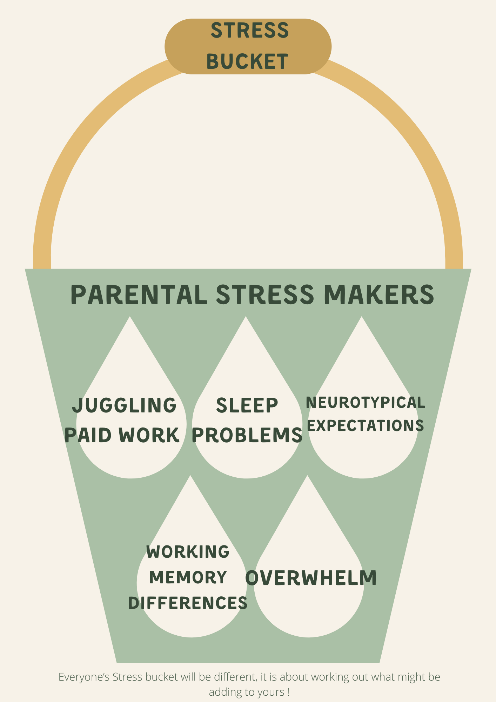
The Stress Bucket
Imagine that your emotional capacity is like a bucket.
The bucket doesn't suddenly overflow because your child throws a tantrum about watching the TV during dinner. It had been filling all day…
You woke up tired.
You made packed lunches for everyone, forgot to make your own.
Your child refused breakfast.
You couldn't find the car keys.
You were late to work or school drop-off.
You skipped lunch.
You had 47 open tabs in your head.
You have had no time to pause and down-regulate.
Then your child is testing a boundary around TV use and mealtimes...
And the bucket overflows.
The final event can look disproportionate to the reaction, but it may not be the whole story.
Research into ADHD and emotional dysregulation supports the idea that difficulties can involve stronger negative emotional responses, including bursts of anger. Although it is not currently formally recognised in diagnostic criteria, there is agreement within research that emotional dysregulation is one of the most common features of ADHD.
This is why widening the lens and looking at events in context can be helpful, especially in fostering self-compassion towards ourselves.
Maybe experiment with, instead of asking “Why did I get so angry about that?”, asking yourself –
“What else am I noticing about this?”
Think about your environment, what has happened in your day, are your basic needs met (e.g. food, drink, sleep, toilet)?
What does ADHD Overwhelm look like in Motherhood?
For many Mums, emotional regulation can look like this:

Many parents go immediately to asking me, how can I break this cycle? How can I change this pattern or change this behaviour? An Occupational Therapist can help by helping you to work out what is happening for you specifically with your Emotional Regulation Cycle and how we can best create change, so that you feel less stress, anger and shame. Tools such as breathing exercises, progressive muscle relaxation, somatic exercises are all useful tools for your toolbox. However, sometimes it is about identifying one simple change, which could have the biggest difference. For some women this could be looking at the impact of:
Poor sleep
Sensory factors like noise
Not having any ‘me time’
Unrealistic expectations from others, or from yourself
Too many household responsibilities
Problems with planning, organising, forgetting
Not knowing how to recover, not having the time to recover or not granting permission to recover
How can Mums with ADHD improve Emotional Regulation?
The first crucial message here is that emotional regulation is not about never getting angry. Anger is a useful and important emotion. All emotions are like signposts on a road, trying to direct us to a need.
You may have heard the term anger is an “umbrella emotion”. The body is extraordinarily clever and, for lots of reasons, which I won’t go into on this post, anger can sometimes hide other emotions such as hurt, panic, sadness and anxiety – just to name a few. Occupational Therapy and ADHD Coaching can help gain clarity on what you are actually feeling, so that we can get clearer about what your unmet needs might be.
The second crucial point, is to know the goal is not to become the world’s calmest parent. The goal is to give yourself more choice in the behaviour that comes with the emotion of anger. Instead of instantly reacting with words that are harsher than we mean or louder than we want them to be, we can move to:
“I am feeling really wound up. What do I need in this moment?”
Can you see how powerful that shift is?
Even if in the moment voices are raised or harsh words are said, it might mean saying to yourself –
“I need to take a time-out to regulate before I can approach repairing this”
Or “What support or resources could help me?”
How can I stop getting angry at my kids as a Mum with ADHD?
A really good first step is to experiment with noticing.
Just simply notice what happens before an outburst or explosion. Are there any warning signs?
Perhaps you were in a rush, late, tired, on your period or hungry?
Notice what happens in your body – what bodily sensations do you notice? For some people:
Your body felt tight
Shoulders tightened
Felt hot
Restless
Everything felt too loud and bright
You felt trapped
These physical sensations are signposting you to your needs. They are literally a bodily ‘stop sign’ – saying we need to pause here, folks, and slow down.
Practical steps to take to improve Emotional Regulation when you have ADHD
A simple approach or emotional regulation framework, for when you notice your emotions are becoming heightened, is the 4 C’s of Emotional Regulation. This is for when you need an in the moment tool, to reduce the chances of you reacting, rather than responding in the way you would choose.

How Wired to Thrive OT supports Neurodivergent families
As a Neurodivergent Occupational Therapist and Coach, I can help you to identify what strategies work specifically to support you. I can help identifying how to make parenting feel more easeful, less stressful and support you being the parent you want to be.
The Wired to Thrive OT approach is different because I take a whole family systems approach – and every neurodivergent family is brilliantly unique, therefore my approach is tailored to match their unique needs.
This might look like:
A. Neurodivergent coaching for a Mum who is feeling overwhelmed and burnt out.
B. It might mean parental strategy sessions to understand how to regulate yourself, so you can co-regulate with your child.
C. It might mean Occupational Therapy for your child.
D. Or it might be a combination.
The aim is to help you to quiet that inner critic, to find some more peace and room for yourself. And for us to work together, to help you understand what works for your brain, your family and your life.
If you are a Mum with ADHD who is exhausted from constantly trying to hold everything together, you don't have to figure it all out on your own.
We can start by understanding what your brain and body are trying to tell you.
About Wired to Thrive OT
Wired to Thrive OT provides neurodivergent-affirming Occupational Therapy, ADHD coaching and Parental coaching.
Available face-to-face in Hampshire and surrounding areas; or online for the whole of the UK.
Find out more about support available through Wired to Thrive OT.
When should you seek medical advice for ADHD and emotional regulation?
Consider talking to your GP or an appropriately qualified professional if emotional difficulties are persistent, are significantly affecting your relationships or functioning, or are accompanied by symptoms of anxiety, depression, trauma or other mental health difficulties.
TL;DR
Being a Mum with ADHD can mean managing a huge amount of executive functioning, sensory and emotional demands; often while also trying to meet your child’s needs.
If you find yourself experiencing rage, overwhelm or burnout, it does not mean that you are a bad Mum. Emotional regulation difficulties can be part of the ADHD experience, and the final outburst may be the result of a bucket that has been filling throughout the day.
Instead of only asking, “Why did I get so angry about that?”, try asking:
“What else am I noticing about this?”
Think about your environment, what has happened in your day, are your basic needs met (e.g. food, drink, sleep)?
Notice what is happening in your body, emotions, environment and daily demands. Look for the things that may be filling your stress bucket - such as poor sleep, sensory overload, hunger, lack of recovery time or an overwhelming mental load.
The goal is not to never feel angry. It is to understand what your anger might be telling you, create more opportunities to pause and regulate, and give yourself more choice in how you respond.
Sometimes, changing just one thing can make all the difference.
And if you are struggling, you do not have to figure it all out alone.
More Confidence. Less Overwhelm. Thrive Your Way.
Please note: While I aim to share accurate and evidence-informed insights, the content of this blog reflects my professional knowledge, interpretations and opinions. I aim to draw on current best practice and available evidence, but there will likely be some human error or information that becomes outdated. This blog is intended for general information and educational purposes and should not be considered a substitute for personalised professional advice.
References
Allen, S. (2026) Motherhood with ADHD: Tips to Cope and Feel Less Overwhelmed. [Online].
Bath, University of (n.d.) ‘Successful career women still shoulder the majority of the mental load at home – new research’. Available at: https://www.bath.ac.uk/announcements/successful-career-women-still-shoulder-the-majority-of-the-mental-load-at-home-new-research/ (Accessed: 4 September 2026).
Beheshti, A. et al. (2020) ‘Emotion dysregulation in adults with attention deficit hyperactivity disorder: a meta-analysis’, BMC Psychiatry, 20, p. 120.
Brown, B. (2013) ‘Shame v. guilt’. Available at: https://brenebrown.com/articles/2013/01/15/shame-v-guilt/ (Accessed: 4 September 2026).
Chronis-Tuscano, A. et al. (n.d.) Research examining parental ADHD symptoms, home chaos and parenting practices. [Further bibliographic details required to complete reference.]
Lotto, C.R., Altafim, E.R.P. and Linhares, M.B.M. (2024) ‘Maternal emotional and behavioral regulation/dysregulation and parenting practices: a systematic review’, Trauma, Violence, & Abuse, 25(5), pp. 3515–3533.
Maternal Mental Health Alliance (2025) ADHD and perinatal mental health: Breaking the silence for neurodivergent mothers. [Online].
National Institute for Health and Care Excellence (NICE) (n.d.) Attention deficit hyperactivity disorder: diagnosis and management (NG87). Available online.
NHS (n.d.) ADHD in adults. Information about adult ADHD, assessment and treatment. Available online.
Perez Algorta, G. et al. (2018) ‘Maternal ADHD symptoms, personality, and parenting stress: Differences between mothers of children with ADHD and mothers of comparison children’, Journal of Attention Disorders, 22(13), pp. 1266–1277.
Siegel, D.J. and Bryson, T.P. (n.d.) The Whole-Brain Child. [Book reference – publication details required.]
Soler-Gutiérrez, A-M. et al. (2023) ‘Evidence of emotion dysregulation as a core symptom of adult ADHD: a systematic review’, PLOS ONE, 18(1), e0280131.
Understood (2024) ‘Emotional regulation, and yelling, as a mom with ADHD’. [Online; included as an example of lived-experience content rather than scientific evidence.]


Comments