
Why 'just try harder' won't work for the ADHD brain
If you have ADHD, you might often find yourself stuck in a freeze, unable to get started on tasks that feel important. It’s frustrating because you want to do the thing, but something inside just won’t let you begin. This experience is common among many people with ADHD, yet it’s often misunderstood by others and even by ourselves. Often we hear ourselves saying "I can't explain it" and becoming increasingly upset as a deadline looms or a friend is coming over for dinner but house is still a mess. People might think you don’t care or don’t want to do the task, but that couldn’t be further from the truth. The real reason lies in how our brains are wired differently.
One of the key parts of the puzzle and something many people are not aware of is that our reward system in fundamentally different. This network is important because it helps us feel motivated, anticipate outcomes, and sustain effort. Understanding this wiring can help you to move past 'stuck' and find ways to thrive. Let’s explore what happens in our brains that causes this freeze feeling and how you can work with it instead of against it.

How ADHD Wiring Creates the Freeze
When you have ADHD, our brain processes motivation and reward differently. The freeze we experience is often linked to how your brain’s reward system works. There is no specific 'reward center', instead it is a circuit involving lots of regions of the brain. As always, regions of the brain rarely work in isolation from eachother. One of the most researched brain differences in ADHD relates to brain regions such as the Ventral Striatum (VS) and Prefrontal Cortex (PFC). If you are like me and need context, see the bottom of this post for word definitions.
Here is the technical bit, a few summaries of the current thinking around this:
Reduced Reward Anticipation: studies using Functional Magnetic Resonance Imaging (fMRI) have found we typically have reduced activation in the VS when anticipating future rewards, in comparison to the more typical neurotype. This means reduced motivation in response to an anticipated future reward.
Reduced activity in the PFC: this weakens our top-down management over our behaviour and there may be weaker coordination between the PFC and the rest of the reward network. This means our PFC's role in making decisions over whether putting in the effort to action something is 'worth it' is less efficient. In real terms, this means that when you get asked to write that boring report, outside of your conscious awareness your PFC is having this dialogue:
"Hmm, well we know the only reward we are going to get for this is a nod of acknowledgment from our boss, in about 2 weeks time when we hand this in...so, I am thinking let's go on Instagram instead for the next 3 hours!"
You can see in this example, the reward being your boss loosely acknowledging your effort, is not tangible and it is not instant and the task itself is perceived by you as boring. Social media on the other hand, is very stimulating and there is an element of social reward and lots of other clever design elements that they integrated to keep your attention and effort hooked. This is how we end up procrastinating, feeling rubbish and sometimes underperforming or getting in trouble.
The Dopamine Hypothesis: simply put, we have altered availability and reduced response in reward circuits of the brain - what is rewarding to our brains, is not rewarding to others and vice versa. Recent research has emphasised that "low dopamine" narratives are overly simplistic. Instead, it is how dopamine signalling dynamics and network interactions change over time and how these interact with other neurotransmitters.
One of the important things to remember, is that these processes are all happening outside of your conscious awareness. So your feelings of "laziness" and "shame" feel very real for you and not being able to explain to your workplace or family, why you haven't done that important thing can be very painful. Unlearning years of 'not knowing 'or living in ableist constructs can take time. I am going give this word a capital C to highlight it's importance, remember Compassion for yourself will help.
Fortunately for us, the research shows us that your brain's reward system is different, you are motivated differently and therefore have differing needs. The next step is all about experimenting with what is helpful and what tools support your own unique brain in getting started and sustaining motivation.
The Take Home message
"Just try harder" won't work.
This is not about will power, this is about how our brains link motivation and reward. Trying harder, pushing through and white knuckling are not sustainable solutions. Increasing how stimulating the task is to you, is often more effective than piling on the pressure.
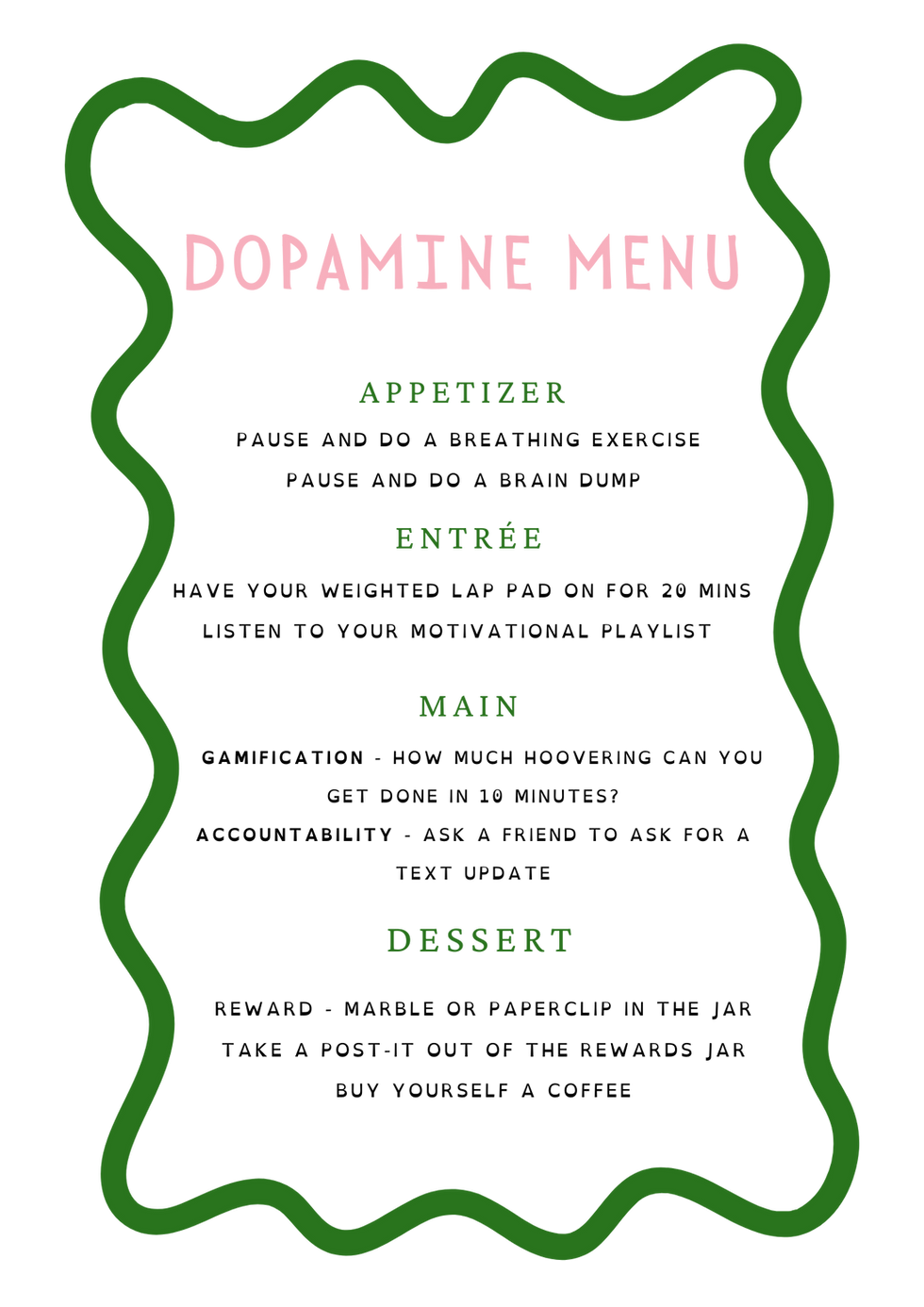
Make yourself a daily dopamine menu
Our brains have a dopamine transporter issue and because of this, when dopamine is low our brains can redirect us to tasks that are stimulating and not important. Stimulation is rewarding to our brains. A delayed reward is not stimulating for our brains. So adding 'dopamine-friendly cues' help us to activate and keep that momentum going. Try a sprinkling of these in your day:
Accountability check-ins e.g. use your coach, partner, friend to check-in with you on your progress
Body doubling i.e. preferably with someone with a typical neurotype
Gamification e.g. give yourself points or use apps that focus on productivity
Visible progress trackers e.g. fill a jar with marbles for every task you complete
Sensory Rewards
Reward Pairing: think of this like pairing your socks, pair the boring sock with a bright colourful, fun sock instead. An example of this could be that you save your favourite playlist, audiobook or podcast to listen to only when doing specific chores in the house
Comfort Burrito: Get yourself your favourite soft blanket to wrap yourself tightly in - lowers your stress levels and gives yourself some deep pressure, a 2 for 1.
Gum chewing or chewy tube on the end of your pen: give it a good gnaw whilst you are doing a boring task - a bit of proprioception for your temporomandibular joint (TMJ) *top tip: avoid this you are stressed*
Need for immediate feedback
The traditional pomodoro technique (25 minutes of work and 5 minute break) may not work here. Dr Russell Barkley suggests the 10/3 Rule (10 minutes of work, 3 minute break). Among other things which I will go into more depth on other posts, this technique leverages the brains wiring for frequent short successes which boost dopamine and sustain motivation.
Celebrating small wins
By breaking tasks down and then celebrating the mini steps for yourself, you will create your own momentum, which will help sustain the effort and get the task finished. An example of a small step could be instead of tasking yourself with "cleaning the house":
Getting the cleaning equipment out of the cupboard
Dusting one shelf
Hoovering the welcome mat
Celebrating yourself each and every part of the way.
Make Rewards "Real"
Amongst other things, this means our brains will not respond well to subtle, abstract rewards. We need to make them "real" to our brains. This is where social rewards, in the form of accountability buddies come in. To nuance this a bit, ADHD brains typically respond well to what I call cheerleading: smiles, praise and high energy feedback. As well as this, allowing yourself that coffee (prize), or a marble in a jar (token) that when full you know you will buy yourself a new pair of jeans or maybe the old school piggy bank effect will be rewarding - get yourself some coins and put one in the jar every time you complete a tricky task.
Understanding Yourself to Thrive
The freeze or the stuck feeling, is not a personal failure. It’s a sign that your brain needs a different approach to motivation. By understanding how your ADHD brain processes rewards, you can find strategies that help you move past the stuck feeling.
Remember, getting started is often the hardest part. Once you find a way to trigger your brain’s reward system, you’ll build momentum and feel more in control.
Try experimenting with these ideas and see what works for your own unique mind and what meets your individual need. The goal is to work with your brain, not against it. When you do, you’ll find that you might be inviting that stranger we call ease into your life and ease will be here to stay, as long as your keep reaching for the tools and strategies you know work for you. No more "try harder", instead "what does my brilliant brain need to get started?" and finally, Compassion with a capital C.
TL;DR
If you have ADHD and feel “frozen” when trying to start important tasks, it’s not laziness or lack of care — it’s brain wiring.
ADHD brains process motivation and reward differently. Research highlights differences in areas like the Ventral Striatum (VS) and Prefrontal Cortex (PFC), which affect how we anticipate rewards, judge effort as “worth it,” and sustain motivation. Delayed, abstract rewards (like praise in two weeks) don’t activate the ADHD brain strongly — but immediate, stimulating experiences (like social media) do.
That’s why “just try harder” doesn’t work. This isn’t a willpower issue — it’s a reward-processing difference.
What does help?
Make rewards immediate and tangible
Increase stimulation (music, body doubling, gamification)
Use short work bursts (e.g., 10 minutes on / 3 minutes off)
Break tasks into tiny steps and celebrate each one
Add visible progress tracking
Build in accountability and social cheerleading
Most importantly: practice Compassion. The freeze is a signal that your brain needs a different motivational strategy — not more shame.
Work with your wiring, not against it.
Wordy Definitions:
Prefrontal cortex (PFC): a fancy word for the part of the brain behind your forehead, a little to the right. If you had a personal executive assistant, this would be it. If we shorten it to PFC, it is responsible for all your higher level thinking, decision making and self control.
Ventral Striatum (VS): sometimes referred to as the 'pleasure center' or 'reward center' of the brain. Essentially this is the part of the brain that in movies could be depicted as that devil and angel on your shoulder, the VS decides how your desires and motivations, impact your choices.
Proprioception: brains awareness of how our body is moving in space i.e. your brains ability to know where your hand is positioned, even when your eyes are closed.
Functional Magnetic Resonance Imaging (fMRI): in layman terms, it is a class of imaging methods using to measure small time variable and regional changes in blood flow to measure things like changes in cognitive state e.g. to measure what happens to our ADHD brains when we fidget, for instance.


Comments